Assiniboine West Watershed District. “We’re preventing the
soil erosion, we’re preventing negative water quality impacts.”
The farm-based conservation network is about to get a lot
richer thanks to a major capital injection from the provincial
government. The Pallister government has launched two new
trusts to fund mainly the environmental projects of the 14
districts of the Manitoba Association of Watersheds (MAW).
It has put $100 million into the Conservation Trust fund,
an endowment from which conservation projects will receive
the annual interest. If the fund, managed by the Winnipeg
Foundation, achieves an annual rate of return of five per cent,
that’s $5 million per year.
As well, the province has put up $52 million in the
Growing Outcomes for Watersheds trust, for which the annual
return will supplement conservation projects, such as ongoing
payments for producers taking land out of production. Five per
cent of $52 million is about $2.5 million annually.
Previously, the entire provincial budget for watershed dis-tricts
was $5 million, plus about $1.7 million from municipali-ties.
This new money will be in addition to that.
“It’s huge. It’s a big shot to our budget,” said Canart. “This
will allow us to do more projects and sign up some of this other
stuff we’ve never done before, like pay guys not to drain.”
The latter reference is to the government’s new stricter
drainage laws. Class 4 and 5 lands, essentially season-long wet-lands,
can no longer be drained. Class 3 lands require mitiga-tion,
meaning that to drain it, somewhere else must be found
to park that water, or cut a cheque to the government to park
that water.
That leaves Class 1 and 2 lands, important habitat for
waterfowl in springtime, but land that can usually be seeded
by June.
“Class 1 and 2 are still vulnerable so you want to target
that land for incentive payments. So you pay guys up to $50 an
acre to leave the wetland intact,” Canart said.
KAP was not happy with the new drainage laws and
Canart thinks the province came up with the new funding to
make the legal changes more palatable for farmers.
“Water quality has always been pushed on us as a priori-ty,”
said Canart. However, it’s probably not the priority for most
farmers. That’s the soil. “The soil, that’s the lifeblood of the
farm. We haven’t been down that road before where we’re pay-ing
producers to recognize their ecological services to society.”
There has been a greater shift in environmental circles
to control drainage, says MAW vice-chair Garry Wasylowski
of Fraserwood, Man. Wasylowski is in the East Interlake
Watershed District, which has four watersheds including
Willow Creek and the Icelandic River.
“One of the key things we’re working on is you can’t do
everything by drainage. You’ve got to do more by water stor-age.
Water storage helps with the drainage problem, but it
will also help with the nutrient-run off problem,” Wasylowski
said. “If you can slow water down, store it, let the cattails and
bulrushes draw phosphorus and nitrogen out, you’re releasing
cleaner water.”
It’s called a passive filter system, and one was recently
installed in the Interlake on David Yablonski’s Triple ‘D’
Ranch. The system prevents nutrient-rich seepage from run-ning
off into the ditches and Lake Winnipeg, which is 16
kilometres away.
Yablonski’s corrals are in a low area and water runs
through them in spring during calving.
The project raised the corrals by about four feet. Now the
water runs off his field into a pit (about the size of an outdoor
hockey rink), from which Yablonski then pumps the water into
a filtering system.
The filtered water is then released into ditches that run
into Lake Winnipeg. The system took three years to develop
and is modelled after the successful effluent treatment system
for the Village of Dunnottar, which reduces phosphorus by up
to 90 per cent.
This is Yablonski’s first year with the system and there has
been no water running through his corrals. He’ll see how the
rest of the system works through the summer. The water can
stay in the pit all summer long.
“For a farmer to do this alone is too costly,” said Yablonski.
The cost is in the range of $100,000. He is required to pick up
only 10 per cent of costs thanks to the watershed district and
government programs.
The farmland in his area could use a lot of drainage, but
many farmers have left ranching over the years, and non-farmers,
many from Winnipeg, are buying up land. People are
paying $80,000 for a quarter section of mostly bush in the area
for recreation, Yablonski says.
Manitoba’s first conservation district was established in
the Whitemud River watershed in 1972. There grew to be 18
conservation districts.
That number was recently reduced to 14 when legislation
passed to realign the districts along watershed boundaries
rather than municipal borders. That caused some boundary
changes and amalgamations.
The legislation had been in the works for at least a dozen
years, but the districts weren’t keen about the overhaul. The
previous NDP government had the legislation on the books,
but never passed it. The current Progressive Conservative gov-ernment
pushed through the legislation, with some tweaks.
WATERSHED DISTRICTS
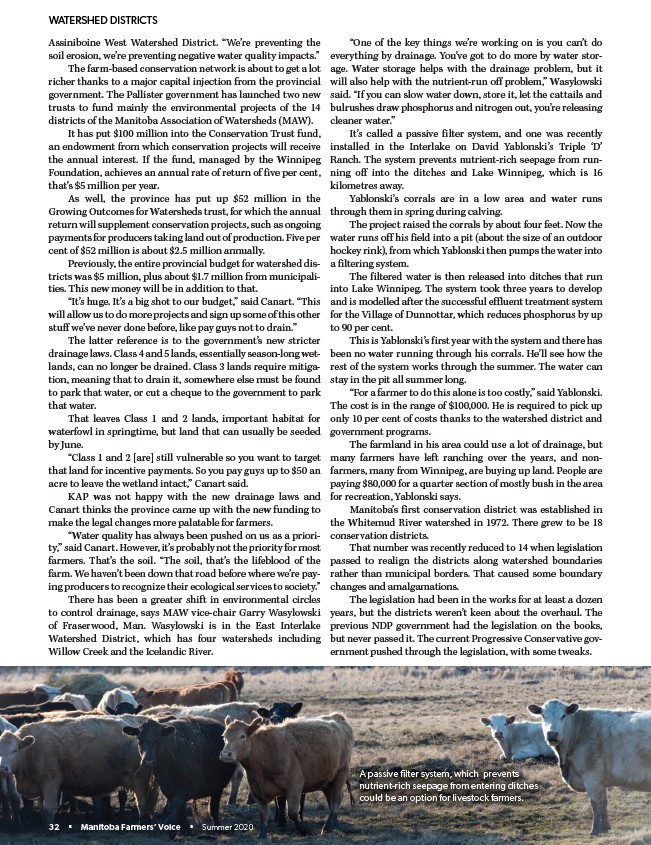
A passive filter system, which prevents
nutrient-rich seepage from entering ditches
could be an option for livestock farmers.
32 § Manitoba Farmers’ Voice § Summer 2020