MEMBER PROFILE – ASSOCIATE
GERDAU Bringing a new level of understanding to industry
Founded by father and son João and Hugo Gerdau, the
Gerdau steel company got its start in 1901 producing
nails in southern Brazil. It has grown from those humble
beginnings to become one of the largest producers of steel in
the Americas.
Today, Gerdau employs more than 30,000 people worldwide
and operates in 10 countries including Mexico, Canada and the
United States. Its network of North American operations includes
10 mills in the U.S. and three others in Canada, which employ
6,200 people and can produce 7.5 million tons of finished steel
products annually.
The company, which has North American headquarters in
Tampa, Fla., became a global player in the steel industry following
its acquisition of Ameristeel in 1999 and the Chaparral Steel
Company in 2007. While the company has continued to grow since
that time, its mission has remained very much the same: produce
quality products and share its knowledge with members of the
construction industry.
“As Gerdau purchased the Chaparral group…it really brought
another level of steel-making knowledge, investments and a longer
term view of the industry,” said Scott Meaney, Gerdau’s director of
product line management, who has been employed by the company
for the past 25 years.
Excited about sheet piling
“Gerdau got people excited about not just the production of sheet
piling, but also the understanding of the retaining wall market and
the potential for growth of steel sheet piling in retaining wall applications,”
said Meaney.
Check out any major building project in the U.S. today and odds
are that it is using one or more Gerdau product in its construction.
The company produces two types of sheet piling at its production
facilities in Petersburg, Va. and Midlothian, Texas – PS Flat Sheets
and PZC Z-sheets – that are used in everything from the construction
of levees, docks and retaining walls to separating contaminated
soil from healthy earth.
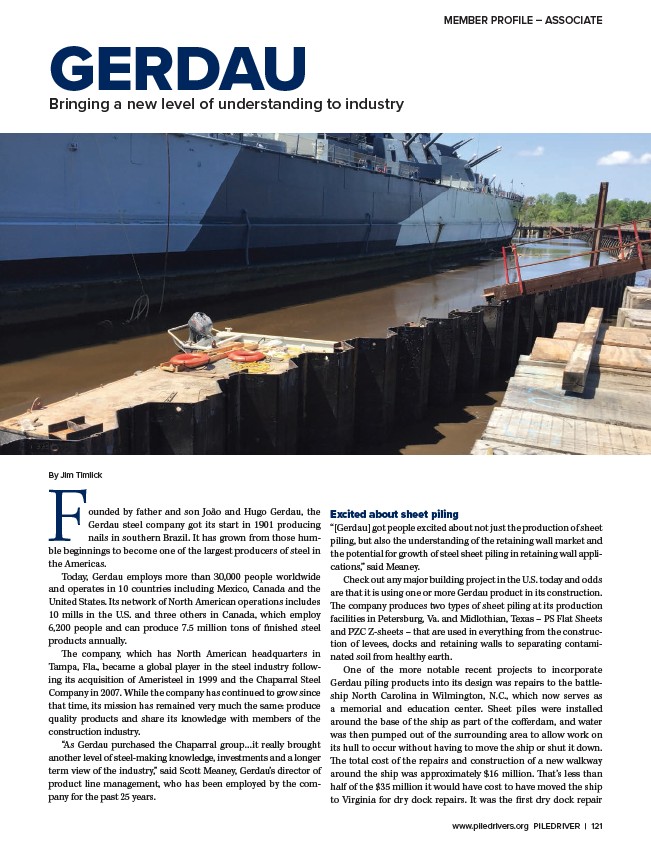
One of the more notable recent projects to incorporate
Gerdau piling products into its design was repairs to the battleship
North Carolina in Wilmington, N.C., which now serves as
a memorial and education center. Sheet piles were installed
around the base of the ship as part of the cofferdam, and water
was then pumped out of the surrounding area to allow work on
its hull to occur without having to move the ship or shut it down.
The total cost of the repairs and construction of a new walkway
around the ship was approximately $16 million. That’s less than
half of the $35 million it would have cost to have moved the ship
to Virginia for dry dock repairs. It was the first dry dock repair
By Jim Timlick
www.piledrivers.org PILEDRIVER | 121
/www.piledrivers.org