Your resource for the use of treated timber piles
P.O. Box 1784, Starkville, MS 39760
Phone: 1-833-745-4647
E-mail: kevin@apta.org
www.timberpilingcouncil.com
Strong ▪ Affordable ▪ Sustainable
PARKER MARINE
CONTRACTING, INC.
John Skinner
Vice President
Email: johnskinner@parkermarine.net
68 Braswell Street
Charleston, S.C. 29405
Office (843) 853-7615
Cell (843) 697-1660
defendant fraudulently concealed the injury or defect. But once the
statute of limitations time period runs out, the potential plaintiff ’s
claim will be barred.
Many states have passed statutes of limitation specific to claims
related to construction. Colorado Revised Statute §13-80-104,
for example, provides that all actions against an architect, contractor,
builder, engineer or inspector for defective construction to an
improvement to real property must be brought within two years
after the claimant discovers, or reasonably should have discovered,
physical evidence of the defect that caused an injury. Illinois’s statute
of limitation, 735 Illinois Compiled Statutes §5/13-214, on the
other hand, bars all claims for defective design, planning, supervision,
observation, management or construction of an improvement
to real property filed more than four years after the person bringing
the claim knew, or should reasonably have known, about the defect.
Likewise, North Carolina General Statutes §1-52 requires plaintiffs
to bring claims for defective improvements to real property within
three years after he or she discovered, or reasonably should have discovered,
the defect.
Florida’s statute of limitation is unique. Section 95.11(3)(c),
amended in 2018, requires plaintiffs alleging a defect in the design,
planning or construction of an improvement to real property to file
within four years after the later of the date of (a) actual possession by
the owner, (b) issuance of a certificate of occupancy, (c) abandonment
of construction if not completed or (d) completion of the contract
or termination of the contract between the professional engineer,
registered architect or licensed contractor and his or her employer.
The statute makes explicit that, for actions involving a latent defect,
the period begins when the defect is discovered or should have been
discovered with the exercise of due diligence. And it adds that a
contractor’s repair or correction of completed work, including warranty
work, performed after the certificate of occupancy or completion
does not delay the start or toll the section 95.11(3)(c)’s statute
of limitation.
Statutes of repose
Statutes of repose, on the other hand, impose time limits that begin
with a specific, or “triggering,” event. The triggering events for construction
defect statutes of repose are often the date of occupancy,
or upon substantial completion of an improvement to real property.
These events start the time period – known as the “repose period” –
regardless of whether the potential plaintiff has discovered the defect.
In other words, even if the defect is latent and the plaintiff only first
discovers it after the end of the repose period, the claim is still barred,
regardless of the fact that it was only just discovered.
That is the critical difference between statutes of limitation and
statutes of repose – the statute of limitation begins to run only after
the claimant discovers, or reasonably should have discovered, the
defect or condition, while the statute of repose begins with the triggering
event and expires at the end of the repose period, regardless of
LEGAL
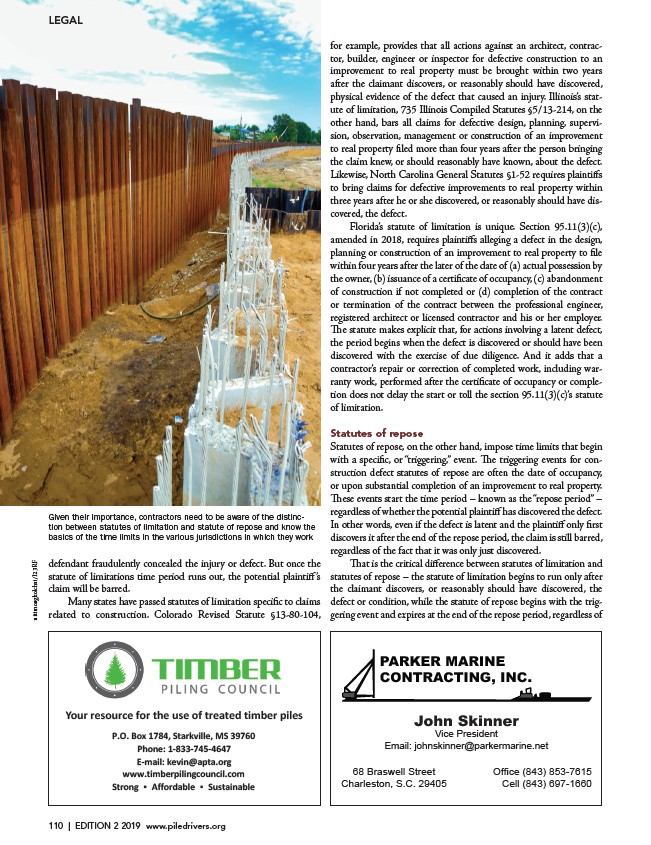
Given their importance, contractors need to be aware of the distinction
between statutes of limitation and statute of repose and know the
basics of the time limits in the various jurisdictions in which they work
nitimongkolchai/123RF
110 | EDITION 2 2019 www.piledrivers.org
/www.timberpilingcouncil.com
/www.piledrivers.org
link
link