prohibited.
M.13. Synthetic slings cannot be used where fumes,
vapors, sprays, mists, or liquids of acids or other
corrosives are present. They also are not to be
used to hoist hot material, or be used near a spark
generating process.
M.14. Synthetic slings must be taken out of service if
there are any cuts, snags, tears, punctures, acid or
caustic burns, melting, broken or worn stitching,
or if the internal red warning threads are showing.
M.15. No sling is to be shortened by using a knot or
other makeshift device.
M.16. Make sure the slings or spreaders are long enough
to pick the load at a minimum sling leg angle. The
closer this angle is to vertical, the less strain there
is on each leg.
M.17. Do not make a spreader leg into a choker by
hooking it back to itself. If you must, at least make
the rigging a basket type and attach the hooks to
the steel ring and not to the eye of the spreader
leg. Just remember, doing this will most likely
permanently kink the legs, and reduce their overall
capacity.
BEST MANAGEMENT PRACTICES
M.18. Shackles and hooks must be inspected for wear
and distortion. The rated capacity must be
stamped on the unit, and are not to be exceeded.
M.19. Loads must be applied to the hook in the throat
area with the safety latch closed. Hooks must have
a safety latch in place, unless the hook is designed
to be used without one, such as a shakeout or
sorting hook. Tip loading of a hook is extremely
dangerous.
M.20. Overhaul (headache) ball swivels have rated
capacities. These are found on a tag or are
stamped into the unit. As with all rigging, this
rated load must not be exceeded. They too must
be inspected for wear and distortion and in
addition, be maintained and lubricated.
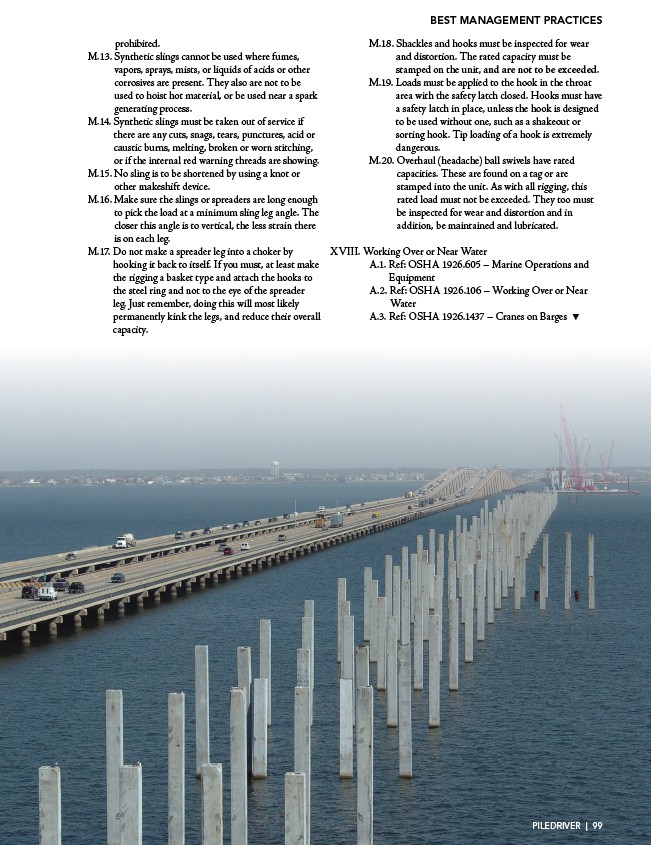
XVIII. Working Over or Near Water
A.1. Ref: OSHA 1926.605 – Marine Operations and
Equipment
A.2. Ref: OSHA 1926.106 – Working Over or Near
Water
A.3. Ref: OSHA 1926.1437 – Cranes on Barges t
PILEDRIVER | 99