Meeting the Challenges
of a Difficult Job
LH Bolduc and American Engineering Testing, Inc. worked together to
tackle the Wayzata Bay redevelopment project
By William Cody and Greg Reuter
This 14-acre site had always been a highly desirable property
due to its proximity to Lake Minnetonka and location
within the City of Wayzata, Minn. However, the site’s
settlement and high maintenance history, due to extensive depths of
highly compressible soils, had blighted previous developments and
scared away redevelopment interests. Teams comprised of investors,
general contractors, architects and engineers came up with redevelopment
concepts in recent years, only to be discouraged when they
realized the likelihood of high initial foundation costs and the risk of
long term problems from “sinking soils.” To overcome this perception,
LH Bolduc and American Engineering Testing (AET) were instrumental
in conveying the value of a pre-design test pile program. We
believe the information from this program (18 pipe piles driven to
various depths in three different areas of the site, dynamically monitored
on restrike over a period of several weeks after initial driving)
and the value engineering initiative that ensued, helped quantify the
risk and brought foundation costs for buildings and infrastructure
into the realm of “economically feasible,” permitting a redevelopment
plan that would finally move forward to a successful completion.
PROJECT SPOTLIGHT
Innovative ideas
To get up and running, just the first phase of the project would
require installation of nearly 1,500 piles, averaging 115 feet in
length. The construction schedule dictated the need for at least
three pile driving rigs – the first rig drove the base section and
spliced the add-on, while the other two rigs performed the final
driving. Four different sized Delmag hammers were used, where
each hammer was used depending on the driving characteristics
and design capacity.
Because we were committed to save pile length and cost, piles
were allowed to set up and capacity determinations were based on
restrike behavior rather than an all-inclusive end of initial drive
blow count and stroke. Driving criteria was developed, based on the
desired pile capacity, pile size, hammer size/energy and subsurface
conditions.
The steel pipe pile selected had to be robust enough to stand up
to occasional debris in the upper fill soils and cobbles and boulders
that can frequent the native glacial deposits at bearing depths. It also
had to be readily available and cost effective. We also wanted a pile
Continued on page 99
Photos courtesy of LH Bolduc and American Engineering Testing
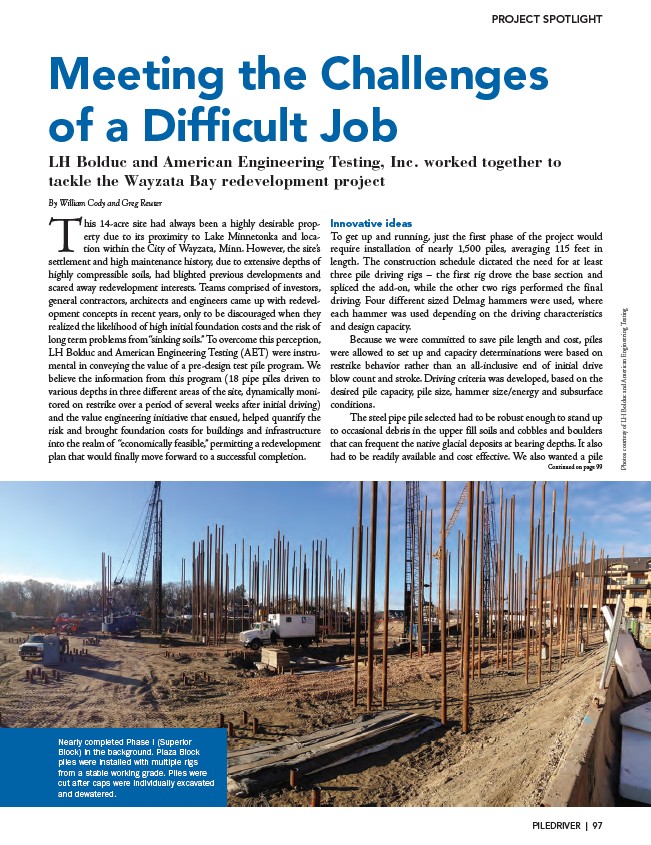
Nearly completed Phase I (Superior
Block) in the background. Plaza Block
piles were installed with multiple rigs
from a stable working grade. Piles were
cut after caps were individually excavated
and dewatered.
PILEDRIVER | 97