Saving Time
and Money
SPIN FIN® dynamic testing for the Downtown Juneau Cruise Ship Berths
By Steven Halcomb, P.E., G.E., Sean Sjostedt, P.E. and Dick Somerville, P.E., PND Engineers, Inc.
The City and Borough of Juneau (CBJ) is constructing two
new floating cruise ship berths to accommodate larger vessels
in downtown Juneau, Alaska. Piles used to construct
the mooring and breasting dolphins will experience large axial loads
from the cruise ship mooring lines and berthing energy. The design
called for piles to be installed to bedrock, therefore, adequate axial
compressive capacity is not expected to be an issue. However, the
existing overburden is soft marine sediment consisting predominantly
of clayey silt and was expected to provide low skin friction
resistance; thus tensile capacity of the piles was a concern. To
accommodate the large tensile loads, PND Engineers, Inc. (PND)
utilized their trademarked SPIN FIN® piles as a cost-saving solution
in lieu of rock anchors to resist the tensile loads. The project
question was: would there be enough pile tensile frictional resistance
with such soft overburden soil?
PND has extensive experience with SPIN FIN® piles, including
static and dynamic load testing; however, limited information
has been researched and developed for SPIN FIN® piles in
soft soils. The SPIN FIN® pile obtains tensile capacity based
on the skin friction along the pile shaft at first, and then additional
bearing due to the fins, much like helical anchors. There is
strong correlation between the skin friction along the pile and the
bearing uplift from the fins; therefore, if accurate skin frictional
information is known, the ultimate capacity of the pile is more
accurately determined.
PND performed high-strain dynamic testing on select piles
during construction to accurately evaluate the driven pile capacity
and help determine whether additional tensile capacity would be
required via rock anchors. Pile Driving Analyzer (PDA) testing was
performed by PND on SPIN FIN®, straight, open-ended steel pipe
piles as well as un-finned, straight, open-ended steel pipe piles to
compare the results of the development of skin friction while driving.
Further, restrikes of select piles were performed to determine
a site-specific setup factor as a function of time. Both vertical and
batter piles were tested.
From October 2015 through February 2016, PND tested
several SPIN FIN® piles with outer diameters of 30 inches and
42 inches. The fins for the piles are typically located at the tip of
the pile and consist of angled flat plates, approximately 15 inches
beyond the pile diameter, one inch thick, and at a 6V:1H (vertical
to horizontal) angle along the pile. The piles were driven with an
APE model 200-6 vibratory hammer to prescribed distances below
the mudline and then impacted with either a Delmag D19-32, D62-
22, or IHC SC-200 Hydrohammer. PND was aided by the general
contractor, Manson Construction Co. (MCC), who provided logistical
and equipment support.
TECHNICAL
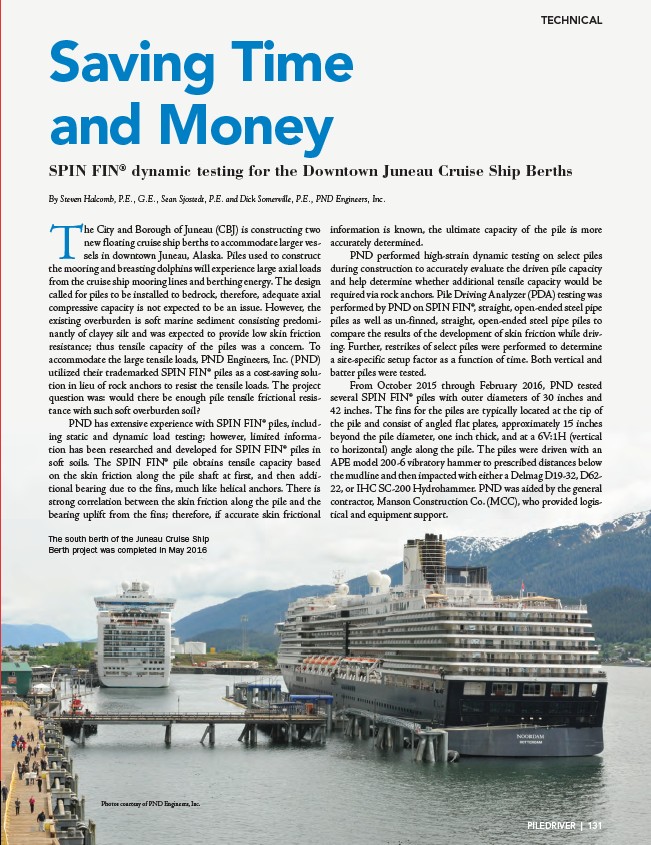
The south berth of the Juneau Cruise Ship
Berth project was completed in May 2016
Photos courtesy of PND Engineers, Inc.
PILEDRIVER | 131