PILE DRIVING,
TIE BACKS and ANCHORS
Pile Load Testing- All Types
to ASTM Standards
• COFFERDAMS
• SEWER & WATER LINES
• BRIDGES
• MARINE CONSTRUCTION
• DAMS
• SLURRY & BARRIER
WALLS
• HEAVY & INDUSTRIAL
FOUNDATIONS
Recommended safe practice for changing
hammer cushions
1. Prior to the start of all operations involving crane or rig movement,
assure that all crewmembers know and are aware that
there is to be only one designated and recognized flag person
giving signals to the operator of heavy equipment.
2. After having determined a safe location for the check or change
of cushions, the hammer shall be lowered to the ground, a
stable mat or secure, stable blocking on deck. All personnel
shall observe the operation and maintain a safe position well
VALUE ENGINEERED SOLUTIONS
TO DIFFICULT PROBLEMS
PILE DRIVING,
TIE BACKS and ANCHORS
Pile Load Testing- All Types
to ASTM Standards
• COFFERDAMS
• SEWER & WATER LINES
• BRIDGES
• MARINE CONSTRUCTION
• DAMS
• SLURRY & BARRIER WALLS
• HEAVY & INDUSTRIAL
FOUNDATIONS
131 California Drive, Williamsville, NY 14221
(716) 632-1125 FAX (716) 632-0705
e-mail piling@HFDarling.com
SERVING NEW YORK, OHIO
and PENNSYLVANIA
clear of the rig movement or sight line of the signalman and
the operator.
3. Once the hammer is lowered to the ground and slack is
observed in the hoisting line, the pins and cable lashings
used to secure the drive cap arrangement to the hammer base
shall be removed and the hammer raised off the drive cap or
capblock and swung aside out of the way and lowered to the
ground, deck or blocked in the leads.
4. The crew can now approach the drive cap, with caution for
residual heat buildup. The striker plate should be carefully
removed. If it is of significant weight or size to not be easily or
safely moved by one individual, it may be necessary to insert
an eye bolt into the provided hole and remove the striker plate
from the cushion pot using the crane line. It is then set aside.
5. The cushion material can then be checked and individual pieces
removed from the pot and replaced by hand. As considerable
heat is generated during operation of the hammer and because
of the mass of the drive cap, it may take a considerable time for
the drive cap to cool. Care should be taken to protect individuals
from burns. Additionally, as cushions are frequently pulverized
or burned in use, eye protection should be employed
during the change out operation.
6. Once the cushion has been checked and/or replaced with new
pieces, the reverse procedure is carried out with the placing of
the striker plate atop the cushion stack, the hammer situated
over the drive cap by the rig and, the hammer lowered while the
crew maintains a safe position out of the way.
7. When the hammer and drive cap are properly aligned, the
cable slings and pins are replaced and the crew returned to
normal operations.
Pile cushions
Pile cushions are provided to not only protect the ends of the concrete
pile from spalling damage that would occur when the hammer
blow impacts the pile, but also to provide attenuation of the blow
during driving, reducing tensile forces acting on the pile as it is
driven. Pile cushions are provided in various thicknesses and sizes
to accommodate the pile, the drive cap size and shape and driving
conditions as determined by the size of the hammer and the soil
characteristics. They are located in a cavity in the underside of a
FEATURE
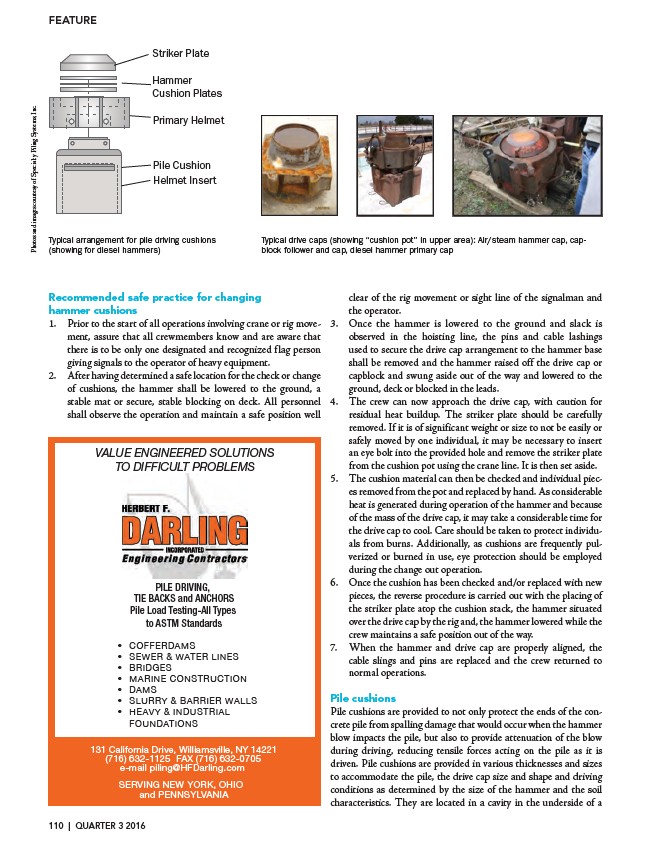
Typical drive caps (showing “cushion pot” in upper area): Air/steam hammer cap, capblock
follower and cap, diesel hammer primary cap
Striker Plate
Hammer
Cushion Plates
Primary Helmet
Pile Cushion
Helmet Insert
Typical arrangement for pile driving cushions
(showing for diesel hammers)
Photos and images courtesy of Specialty Piling Systems, Inc.
110 | QUARTER 3 2016
link