and a lot of export packaging needs,” said
Franks. “Local business remains a focus
for us, where the oil and gas industry has a
strong need for forestry products for export
packing. However, our cut-to-size plywood
business takes us out of Texas, and throughout
the Midwest. Wisconsin is one of our
biggest ship-to states and we ship there multiple
times per week. So, we’re doing business
1,200 to 1,300 miles away, with wood
products that are locally sourced, manufactured
and processed here.”
The wood they use is even local.
“The majority of our lumber is
Southern Yellow Pine, and that species
is grown from East Texas all the way to
Georgia and South Carolina, generally your
southern states,” said Lodge.
And, like a lot of companies in the
construction industry, Lodge Lumber finds
itself involved in a variety of different projects.
“Our projects include bridges, piers,
wharves, deep foundations for buildings,
deep foundations for industrial plants,
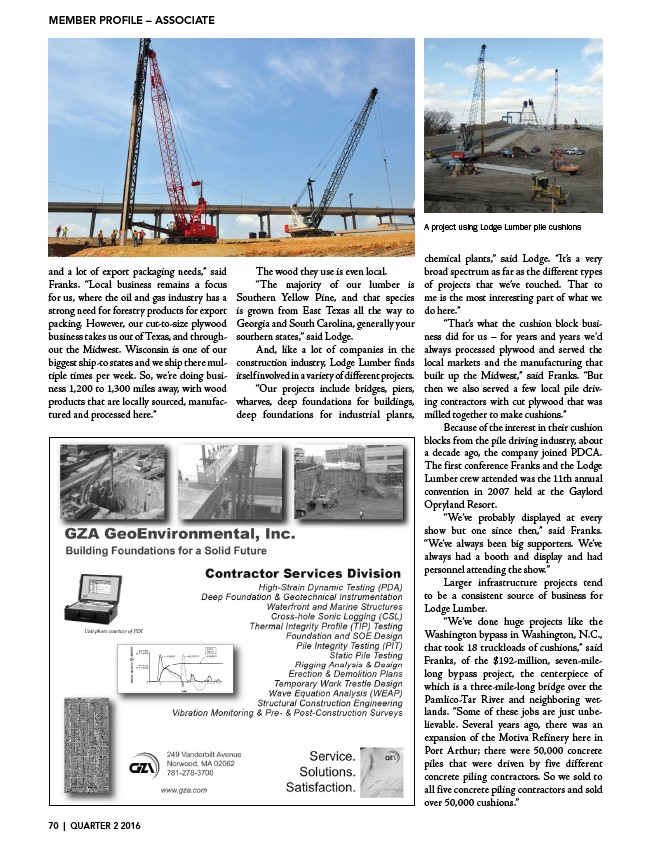
A project using Lodge Lumber pile cushions
MEMBER PROFILE – ASSOCIATE
chemical plants,” said Lodge. “It’s a very
broad spectrum as far as the different types
of projects that we’ve touched. That to
me is the most interesting part of what we
do here.”
“That’s what the cushion block business
did for us – for years and years we’d
always processed plywood and served the
local markets and the manufacturing that
built up the Midwest,” said Franks. “But
then we also served a few local pile driving
contractors with cut plywood that was
milled together to make cushions.”
Because of the interest in their cushion
blocks from the pile driving industry, about
a decade ago, the company joined PDCA.
The first conference Franks and the Lodge
Lumber crew attended was the 11th annual
convention in 2007 held at the Gaylord
Opryland Resort.
“We’ve probably displayed at every
show but one since then,” said Franks.
“We’ve always been big supporters. We’ve
always had a booth and display and had
personnel attending the show.”
Larger infrastructure projects tend
to be a consistent source of business for
Lodge Lumber.
“We’ve done huge projects like the
Washington bypass in Washington, N.C.,
that took 18 truckloads of cushions,” said
Franks, of the $192-million, seven-milelong
bypass project, the centerpiece of
which is a three-mile-long bridge over the
Pamlico-Tar River and neighboring wetlands.
“Some of these jobs are just unbelievable.
Several years ago, there was an
expansion of the Motiva Refinery here in
Port Arthur; there were 50,000 concrete
piles that were driven by five different
concrete piling contractors. So we sold to
all five concrete piling contractors and sold
over 50,000 cushions.”
70 | QUARTER 2 2016