Figure 7. Baseline and time-elapsed post-improvement relative density and fines content as
correlated from cone tip resistance
FEATURE
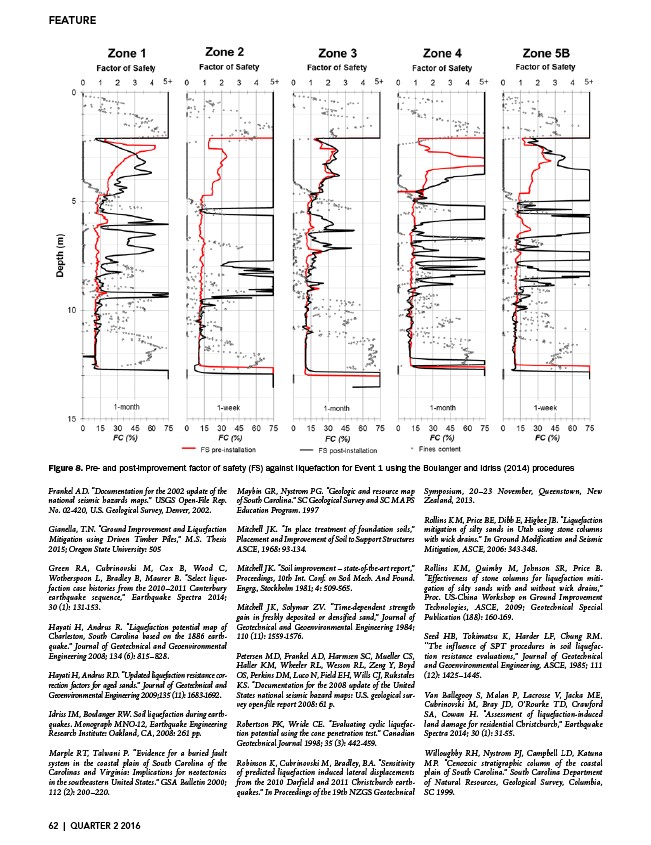
Figure 8. Pre-Figure and 8. Pre-post- and post-improvement improvement factor of safety factor (FS) against of liquefaction safety for (Event FS)1 using against the Boulanger liquefaction and Idriss (2014) procedures
for Event 1 using Boulanger and Idriss (2014) procedures
Frankel AD. “Documentation for the 2002 update of the
national seismic hazards maps.” USGS Open-File Rep.
No. 02-420, U.S. Geological Survey, Denver, 2002.
Gianella, T.N. “Ground Improvement and Liquefaction
Mitigation using Driven Timber Piles,” M.S. Thesis
2015; Oregon State University: 505
Green RA, Cubrinovski M, Cox B, Wood C,
Wotherspoon L, Bradley B, Maurer B. “Select liquefaction
case histories from the 2010–2011 Canterbury
earthquake sequence,” Earthquake Spectra 2014;
30 (1): 131-153.
Hayati H, Andrus R. “Liquefaction potential map of
Charleston, South Carolina based on the 1886 earthquake.”
Journal of Geotechnical and Geoenvironmental
Engineering 2008; 134 (6): 815–828.
Hayati H, Andrus RD. “Updated liquefaction resistance correction
factors for aged sands.” Journal of Geotechnical and
Geoenvironmental Engineering 2009;135 (11): 1683-1692.
Idriss IM, Boulanger RW. Soil liquefaction during earthquakes.
Monograph MNO-12, Earthquake Engineering
Research Institute: Oakland, CA, 2008: 261 pp.
Marple RT, Talwani P. “Evidence for a buried fault
system in the coastal plain of South Carolina of the
Carolinas and Virginia: Implications for neotectonics
in the southeastern United States.” GSA Bulletin 2000;
112 (2): 200–220.
Maybin GR, Nystrom PG. “Geologic and resource map
of South Carolina.” SC Geological Survey and SC MAPS
Education Program. 1997
Mitchell JK. “In place treatment of foundation soils,”
Placement and Improvement of Soil to Support Structures
ASCE, 1968: 93-134.
Mitchell JK. “Soil improvement – state-of-the-art report,”
Proceedings, 10th Int. Conf. on Soil Mech. And Found.
Engrg., Stockholm 1981; 4: 509-565.
Mitchell JK, Solymar ZV. “Time-dependent strength
gain in freshly deposited or densified sand,” Journal of
Geotechnical and Geoenvironmental Engineering 1984;
110 (11): 1559-1576.
Petersen MD, Frankel AD, Harmsen SC, Mueller CS,
Haller KM, Wheeler RL, Wesson RL, Zeng Y, Boyd
OS, Perkins DM, Luco N, Field EH, Wills CJ, Rukstales
KS. “Documentation for the 2008 update of the United
States national seismic hazard maps: U.S. geological survey
open-file report 2008: 61 p.
Robertson PK, Wride CE. “Evaluating cyclic liquefaction
potential using the cone penetration test.” Canadian
Geotechnical Journal 1998; 35 (3): 442-459.
Robinson K, Cubrinovski M, Bradley, BA. “Sensitivity
of predicted liquefaction induced lateral displacements
from the 2010 Darfield and 2011 Christchurch earthquakes.”
In Proceedings of the 19th NZGS Geotechnical
Symposium, 20–23 November, Queenstown, New
Zealand, 2013.
Rollins KM, Price BE, Dibb E, Higbee JB. “Liquefaction
mitigation of silty sands in Utah using stone columns
with wick drains.” In Ground Modification and Seismic
Mitigation, ASCE, 2006: 343-348.
Rollins KM, Quimby M, Johnson SR, Price B.
“Effectiveness of stone columns for liquefaction mitigation
of silty sands with and without wick drains,”
Proc. US-China Workshop on Ground Improvement
Technologies, ASCE, 2009; Geotechnical Special
Publication (188): 160-169.
Seed HB, Tokimatsu K, Harder LF, Chung RM.
‘‘The influence of SPT procedures in soil liquefaction
resistance evaluations,” Journal of Geotechnical
and Geoenvironmental Engineering, ASCE, 1985; 111
(12): 1425–1445.
Van Ballegooy S, Malan P, Lacrosse V, Jacka ME,
Cubrinovski M, Bray JD, O’Rourke TD, Crawford
SA, Cowan H. “Assessment of liquefaction-induced
land damage for residential Christchurch,” Earthquake
Spectra 2014; 30 (1): 31-55.
Willoughby RH, Nystrom PJ, Campbell LD, Katuna
MP. “Cenozoic stratigraphic column of the coastal
plain of South Carolina.” South Carolina Department
of Natural Resources, Geological Survey, Columbia,
SC 1999.
Acknowledgements
The authors wish to thank the sponsors of this research, which includes the National
Cooperative Highway Research Program under grant NCHRP-180, and the South Carolina
chapter of the Pile Driving Contractors Association (PDCA). The authors gratefully
acknowledge the significant effort by Van Hogan, formerly of the PDCA, as well as member firms that have contributed materials, labor, and equipment: Pile Drivers, Inc.,ME, Soil Consultants Inc., Chuck Dawley Surveying, Cox Wood Industries, and Hayward
Baker, Inc.
62 | QUARTER 2 2016