LEGAL
TIMBER PILE
UPLIFT ANCHORS
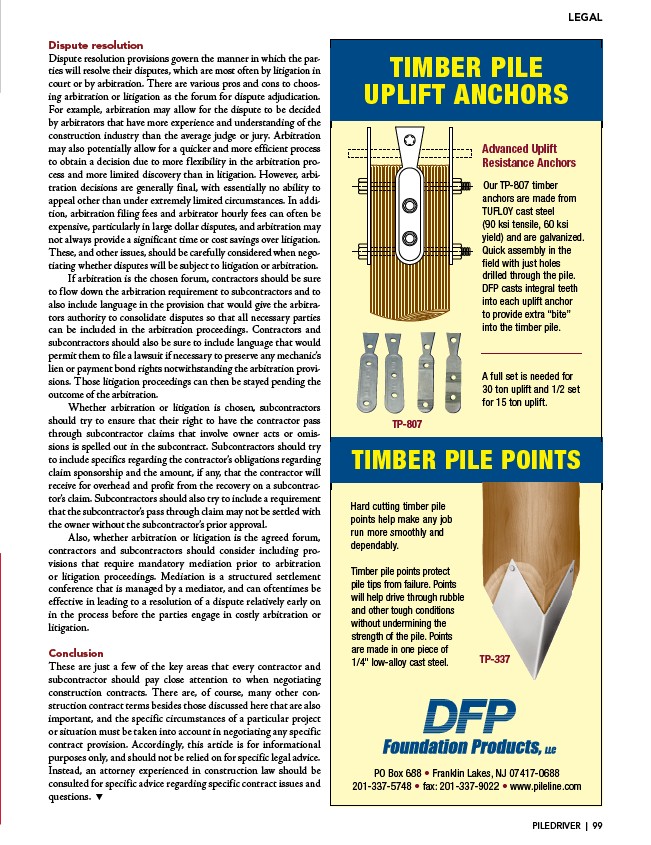
TP-807
TIMBER PILE POINTS
Hard cutting timber pile
points help make any job
run more smoothly and
dependably.
Timber pile points protect
pile tips from failure. Points
will help drive through rubble
and other tough conditions
without undermining the
strength of the pile. Points
are made in one piece of
1/4" low-alloy cast steel.
Advanced Uplift
Resistance Anchors
Our TP-807 timber
anchors are made from
TUFLOY cast steel
(90 ksi tensile, 60 ksi
yield) and are galvanized.
Quick assembly in the
field with just holes
drilled through the pile.
DFP casts integral teeth
into each uplift anchor
to provide extra “bite”
into the timber pile.
A full set is needed for
30 ton uplift and 1/2 set
for 15 ton uplift.
TP-337
PO Box 688 • Franklin Lakes, NJ 07417-0688
201-337-5748 • fax: 201-337-9022 • www.pileline.com
Dispute resolution
Dispute resolution provisions govern the manner in which the parties
will resolve their disputes, which are most often by litigation in
court or by arbitration. There are various pros and cons to choosing
arbitration or litigation as the forum for dispute adjudication.
For example, arbitration may allow for the dispute to be decided
by arbitrators that have more experience and understanding of the
construction industry than the average judge or jury. Arbitration
may also potentially allow for a quicker and more efficient process
to obtain a decision due to more flexibility in the arbitration process
and more limited discovery than in litigation. However, arbitration
decisions are generally final, with essentially no ability to
appeal other than under extremely limited circumstances. In addition,
arbitration filing fees and arbitrator hourly fees can often be
expensive, particularly in large dollar disputes, and arbitration may
not always provide a significant time or cost savings over litigation.
These, and other issues, should be carefully considered when negotiating
whether disputes will be subject to litigation or arbitration.
If arbitration is the chosen forum, contractors should be sure
to flow down the arbitration requirement to subcontractors and to
also include language in the provision that would give the arbitrators
authority to consolidate disputes so that all necessary parties
can be included in the arbitration proceedings. Contractors and
subcontractors should also be sure to include language that would
permit them to file a lawsuit if necessary to preserve any mechanic’s
lien or payment bond rights notwithstanding the arbitration provisions.
Those litigation proceedings can then be stayed pending the
outcome of the arbitration.
Whether arbitration or litigation is chosen, subcontractors
should try to ensure that their right to have the contractor pass
through subcontractor claims that involve owner acts or omissions
is spelled out in the subcontract. Subcontractors should try
to include specifics regarding the contractor’s obligations regarding
claim sponsorship and the amount, if any, that the contractor will
receive for overhead and profit from the recovery on a subcontractor’s
claim. Subcontractors should also try to include a requirement
that the subcontractor’s pass through claim may not be settled with
the owner without the subcontractor’s prior approval.
Also, whether arbitration or litigation is the agreed forum,
contractors and subcontractors should consider including provisions
that require mandatory mediation prior to arbitration
or litigation proceedings. Mediation is a structured settlement
conference that is managed by a mediator, and can oftentimes be
effective in leading to a resolution of a dispute relatively early on
in the process before the parties engage in costly arbitration or
litigation.
Conclusion
These are just a few of the key areas that every contractor and
subcontractor should pay close attention to when negotiating
construction contracts. There are, of course, many other construction
contract terms besides those discussed here that are also
important, and the specific circumstances of a particular project
or situation must be taken into account in negotiating any specific
contract provision. Accordingly, this article is for informational
purposes only, and should not be relied on for specific legal advice.
Instead, an attorney experienced in construction law should be
consulted for specific advice regarding specific contract issues and
questions. t
PILEDRIVER | 99
/www.pileline.com