PROJECT SPOTLIGHT
Cape Romain Contractors helps to preserve
history with driven piles
By Sonny DuPre, Cape Romain Contractors
Sullivan’s Island in South Carolina, a barrier island protecting the mouth of Charleston
Harbor, played an important military-defense role, dating back to the Revolutionary
War era. The island was named for Captain Florence O’Sullivan, who came
to the Colonies in 1669. Captain O’Sullivan was in charge of large cannons placed at the
southern tip of the island, to warn Charlestowne of ships at the mouth of the harbor. At the
outset of the Revolutionary War, Fort Moultrie was constructed on the island, to protect
Charleston from the British.
Just prior to 1800, the U.S. government acquired additional property on Sullivan’s
Island wherein various fortifications and structures were built. Those structures served
to protect the Confederacy, and subsequently the United States during such wars as the
Spanish American War, up thru World War II.
The Quartermasters House and the Quartermasters Dock, the subjects of this
article, were constructed in the very early 1900s, as the U.S. government sought to expand
fortifications and military infrastructure. The dock was a heavy, wooden, pile-supported
structure, with a Quartermasters house, whereby barges could be loaded and unloaded,
furnishing supplies, equipment and ammunition to the various fortifications and barracks.
The fort was deactivated in 1947 and most of the property was dispersed by the War
Assets Administration. The Quartermaster Dock was listed in the National Register
September 6, 2007. The property was then auctioned off and purchased by Steven Poletti,
M.D., in March of 2013. The dock and house replacement project was bid in the winter
of 2013, and soon thereafter, Cape Romain Contractors, proud member of the PDCA of
South Carolina Chapter, was awarded the project.
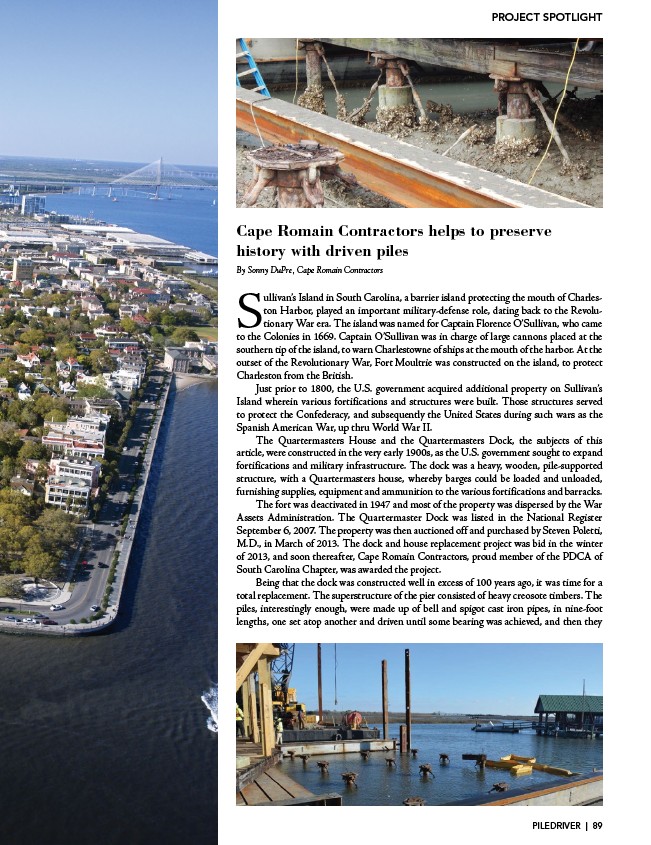
Being that the dock was constructed well in excess of 100 years ago, it was time for a
total replacement. The superstructure of the pier consisted of heavy creosote timbers. The
piles, interestingly enough, were made up of bell and spigot cast iron pipes, in nine-foot
lengths, one set atop another and driven until some bearing was achieved, and then they
PILEDRIVER | 89