Pile Driving Monitoring
by the Foundation Testing Experts
GRL evaluates:
Capacity during driving
by Case Method or iCAP®
Integrity, Driving Stresses
and Hammer Performance
Total Bearing Capacity
by CAPWAP®
Ask about
remote testing
to lower costs and
ease scheduling
Quick response...results you can trust
California .............. 323.441.0965
Colorado .............. 303.666.6127
Florida .................. 407.826.9539
Illinois ................... 847.221.2750
Louisiana .............. 985.640.7961
North Carolina ...... 704.593.0992
Ohio ...................... 216.831.6131
Pennsylvania ........ 610.459.0278
Texas .................... 832.389.1156
Washington .......... 425.381.9690
Central Offi ce ....... 216.831.6131
www.GRLengineers.com/PDM info@GRLengineers.com
VIBRATORY PILE
DRIVER/EXTRACTOR
SALES PARTS SERVICE RENTALS
DIRECT LINE: 866-262-4181 companywrench.com
WATCH THE MKT PILEDRIVER IN ACTION
http://companywrench.com/mkt_piledriving.html
GOH to facilitate truss erection, 16-inch steel pipe piles bents were
driven for the support and eliminate to the risk of erosion damaging
the towers, if a flood event would occur.
Winter operations
The original construction schedule included a winter shutdown,
however delays due to dewatering operations necessitated winter
work to maintain the project schedule. In addition to form insulation,
internal cooling pipes were utilized in the pier stems to minimize
internal temperatures and temperature differentials for the
350 cubic yard placements. A thermal control plan was design by
GOH and internal temperatures of the concrete in the larger pours
were closely monitored during curing periods.
Shop fabrication and steel erection
Streamlined shop drawing submissions were accepted to meet
the aggressive construction schedule. All steel fabrications were
detailed using three-dimensional software, and shop drawings were
limited to typical connection and member details. These drawings
provided enough information to convey 3D model accuracy and to
allow the third party shop inspector to complete all inspections.
Steel erection proceeded from the east abutment and worked west
with no significant delays or problems encountered. Each through
girder span one and three was erected in five days (118 feet, two
inches), and the truss span two (237 feet, nine inches) was erected
in six weeks. Tension control bolts around 40 ton was used to
reduce the time needed to perform final torque on all bolts.
Constant communication between the engineer, contractor
and owner allowed all of these items to be addressed quickly, thus
maintaining the completion date and controlling costs, without
sacrificing quality. The bridge was completed on time, and the
first train ran on July 2, 2014, culminating the largest project the
JRA has completed to date. The final construction included over
1.5 million pounds of structure steel and bolts; 2,300 cubic yards
of reinforced concrete; 228,895 pound of reinforcing steel; and
over one half-mile of new track construction and was completed in
12 months. The completed project allows the Authority to fulfill
its mission of providing uninterrupted service to its clients and
continuing to encourage economic growth within JRA’s member
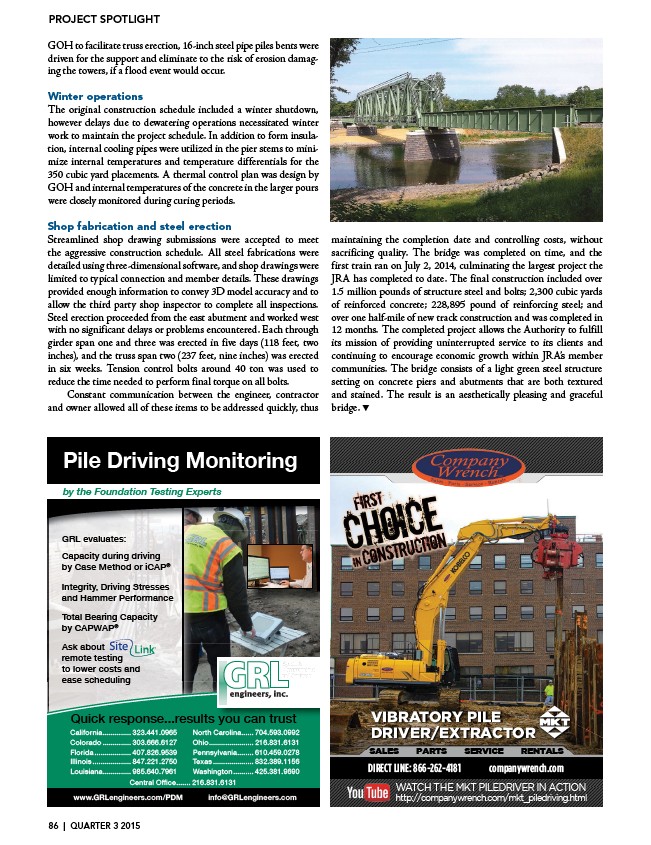
communities. The bridge consists of a light green steel structure
setting on concrete piers and abutments that are both textured
and stained. The result is an aesthetically pleasing and graceful
bridge. t
PROJECT SPOTLIGHT
86 | QUARTER 3 2015
/mkt_piledriving.html
/companywrench.com
/PDM
link